The Hidden System That Decides Where Your Attention Goes
Why your brain notices some things instantly while ignoring others

Picture this. You sit down to focus on something important.
You open your laptop. You begin reading. For a moment, your attention feels stable.
Then your phone lights up.
Even before you consciously think about it, part of your attention shifts.
Not because you made a decision.
Because your brain detected something it considered important.
A small signal instantly pulled your focus away.
Your brain starts scanning:
• “Could this matter?”
• “Should I check this?”
• “What if this is important?”
Most people think attention works like a choice.
But neuroscience shows that attention begins much earlier than conscious thought.
Your brain is constantly deciding what deserves priority.
And most of that process happens automatically.
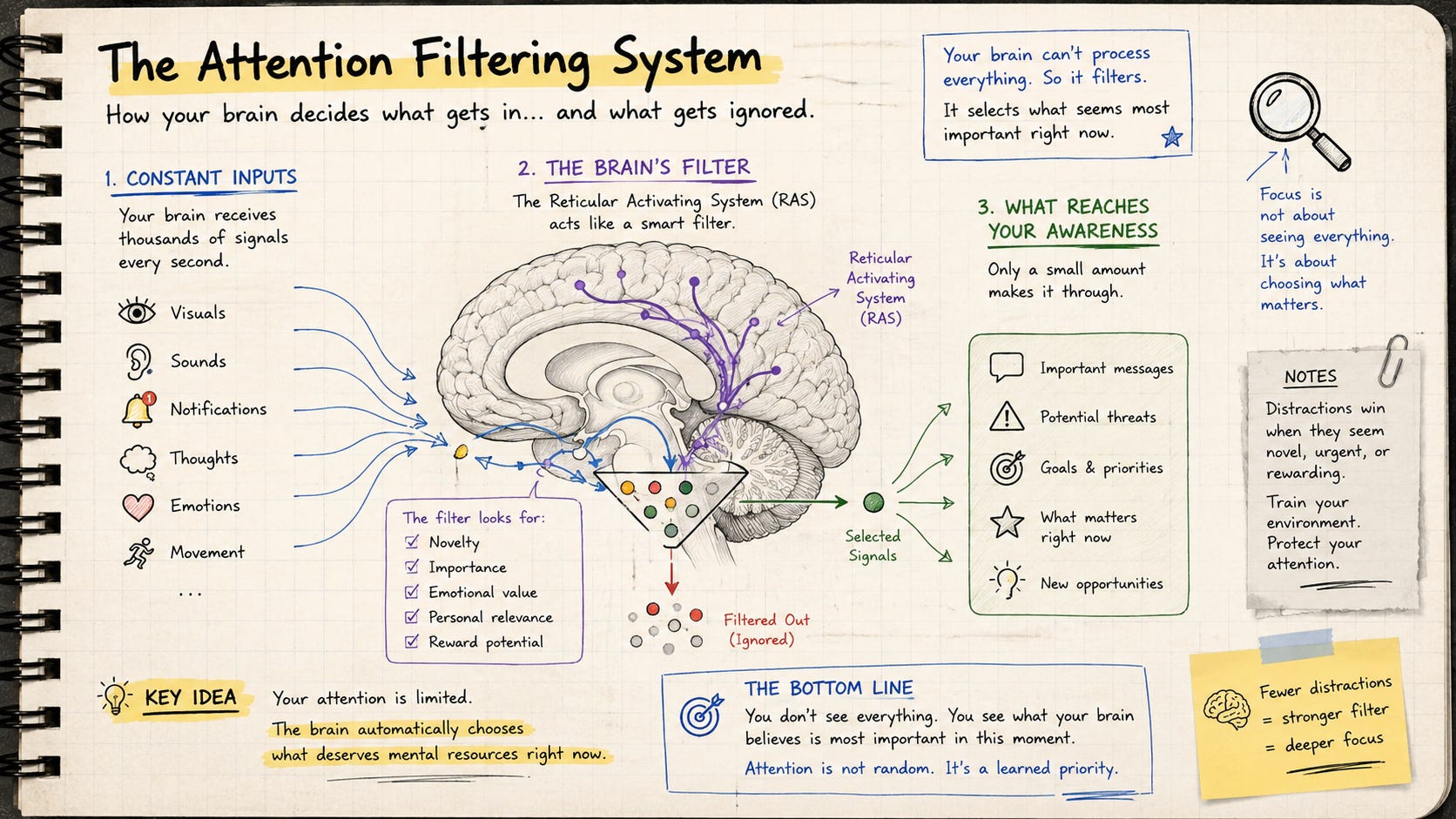
Your Brain Cannot Process Everything
Every second, your brain receives massive amounts of information.
Sounds
Movement
Thoughts
Notifications
Emotions
Visual signals
If your brain tried to fully process all of it, you would become overwhelmed immediately.
So the brain filters.
It constantly selects what seems most relevant.
This process is controlled by attention systems deep inside the brain.
The Key Insight
Attention is not just about focus.
It is about selection.
Your brain is always deciding:
What deserves mental resources right now?
The Reticular Activating System
One important system involved in attention is called the Reticular Activating System, often shortened to the RAS.
This network acts like a filter between the outside world and conscious awareness.
Its job is simple:
Identify what stands out.
The RAS prioritizes signals based on:
Novelty
Emotion
Movement
Personal relevance
Reward potential
This is why you instantly notice your name in a crowded room.
Or why your attention jumps toward notifications even when you are trying to ignore them.
Your brain is trained to detect signals that may matter.
Why Attention Gets Pulled So Easily
Modern environments constantly activate this system.
Bright colors
Quick movement
Notifications
Unexpected information
All of these create what neuroscience calls salience.
Salience means something stands out strongly enough to grab attention.
Your brain evolved to notice important changes quickly.
The problem is that modern technology continuously creates artificial salience.
So your attention keeps getting interrupted.
The Dopamine Connection
Dopamine also plays a role in attention.
Not because it creates focus directly.
But because it increases sensitivity toward rewarding signals.
When something might provide stimulation or reward, dopamine activity increases.
This tells the brain:
“Pay attention to this.”
Over time, your brain learns which signals deserve fast attention.
And repeated exposure strengthens those patterns.
Why Deep Focus Feels Fragile
Focused attention requires stability.
But the attention system is designed to monitor the environment continuously.
Part of your brain always stays alert for new information.
This is why even small interruptions feel powerful.
A single notification can pull resources away from deep thinking almost instantly.
Not because your focus is weak.
Because the brain prioritizes change and novelty automatically.
Cognitive Switching Costs
Each time attention shifts, the brain must reorient itself.
This process consumes mental energy.
Neuroscientists call this switching cost.
Examples:
• Reading, then checking your phone
• Writing, then answering a message
• Thinking deeply, then opening social media
Each switch forces the brain to reset context.
And repeated switching increases mental fatigue throughout the day.
Why Certain Things Keep Winning Your Attention
Your brain learns from repetition.
If certain signals repeatedly provide stimulation, relief, or reward, the attention system begins prioritizing them faster.
This creates automatic patterns.
Examples:
• Constantly checking notifications
• Looking for stimulation during boredom
• Switching tasks whenever effort increases
Over time, the brain starts expecting interruption.
Stillness begins to feel unfamiliar.
The Brain Can Relearn Attention
The good news is that attention systems are highly adaptable.
The brain changes based on repeated experience.
This is called neuroplasticity.
When you reduce unnecessary stimulation and spend more time focusing on one thing, the brain slowly adjusts.
Attention becomes more stable.
Interruptions feel less powerful.
Deep focus becomes easier to maintain.
Not instantly.
But gradually.
How to Help the Attention System
You do not need perfect discipline.
You need fewer competing signals.
Examples:
• Silence notifications
• Reduce visual clutter
• Work on one task at a time
• Create short periods without stimulation
This lowers the number of signals fighting for attention.
And the brain begins to settle.
A Better Way to Understand Focus
Focus is not about forcing attention to stay.
It is about reducing the number of things trying to pull it away.
Your brain is always selecting what feels most important.
The environment shapes those selections more than most people realize.
A Final Thought
Your attention is not random.
It is trained.
Every signal you repeatedly respond to teaches the brain something about what matters.
And over time, those small choices shape how your mind moves through the world.
The question is not only:
“What am I focusing on?”
But also:
“What am I teaching my brain to notice?”